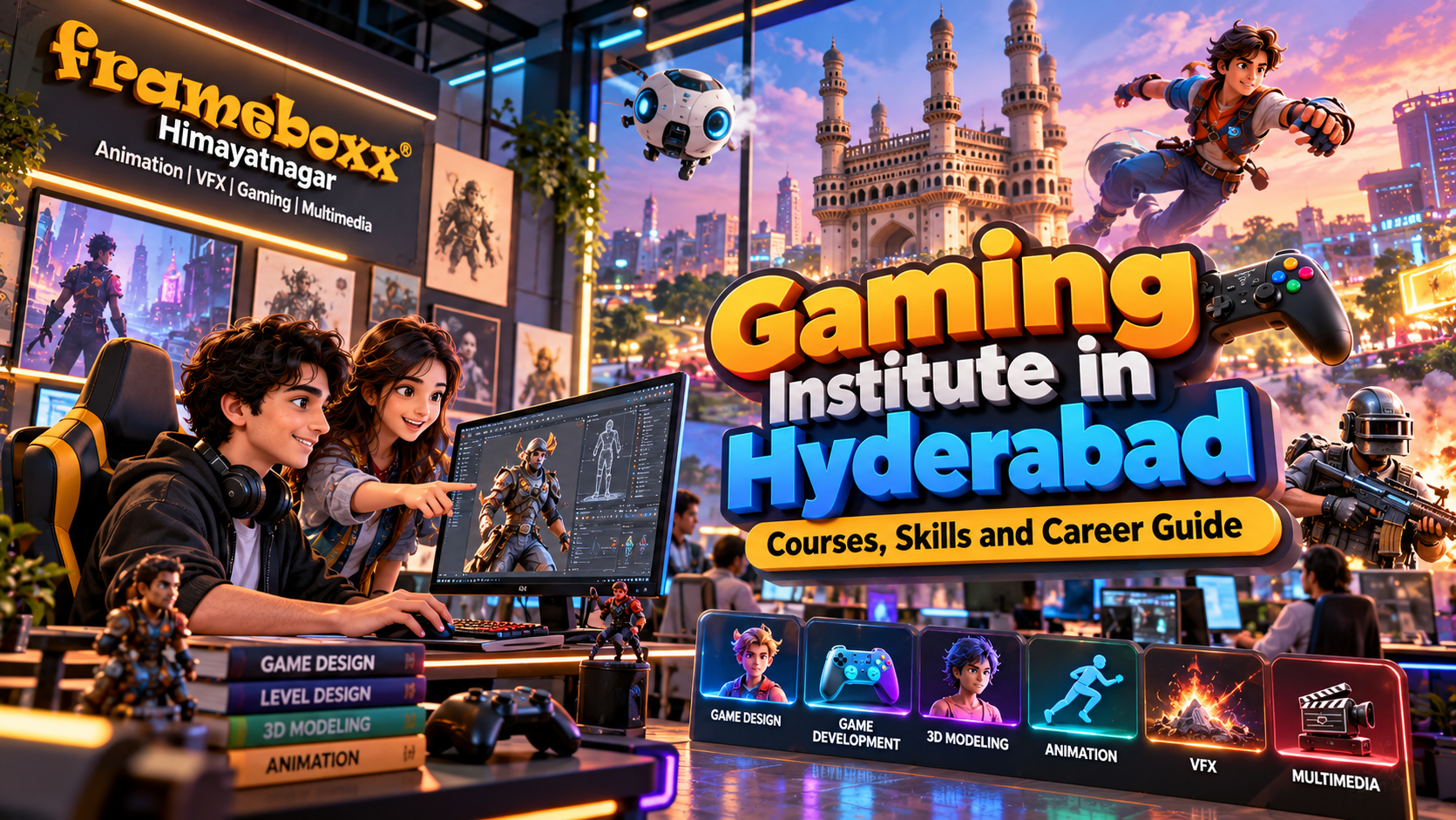
Playing a video game and creating one require very different skills. If you want to turn your interest in gaming into a creative or technical career, choosing the right training program is an important first step. A gaming institute in Hyderabad can help you explore game art, game design, 3D asset creation, and game development, provided its curriculum matches your career goals and gives you opportunities to build practical projects.
For students, graduates, and aspiring creators, the right choice starts with understanding how games are made, which specialization suits your strengths, and what you should learn before enrolling. Frameboxx Himayatnagar offers access to a range of creative training programs, including gaming-related learning options listed on its course website. Before selecting a program, you should verify its current curriculum, duration, fees, and availability at the Hyderabad center.
What Is a Gaming Institute?
A gaming institute is an educational training center that teaches the creative, technical, and production skills involved in creating video games and interactive digital experiences. Depending on its programs, it may cover game art, 3D modeling, character creation, level design, game mechanics, programming, and the use of game engines.
A gaming institute is different from a conventional gaming lounge. A gaming lounge provides access to games for entertainment, while a training institute focuses on the process of making them. Students learn how visual assets, gameplay systems, interactive environments, and software tools work together to produce a playable experience.
The scope of training depends on the selected course. Some programs focus on the artistic side of game production, while others emphasize development, technical implementation, or production planning.
For example, a game artist may create a character and its textures, whereas a game developer may implement the character's movement and interactions inside a game engine. Both roles contribute to the same project, but they require different skills.
When searching for a gaming institute in Hyderabad, therefore, look beyond the word "gaming." Identify whether you want to design visual assets, plan gameplay, develop interactive systems, or understand several parts of the production process.
What Do You Learn at a Gaming Institute in Hyderabad?
A gaming course can introduce you to the complete game production process or focus on a specific discipline. The subjects you study should depend on your chosen specialization, experience level, and intended career path.
1. Game Art and Asset Creation
Game art focuses on the visual elements that make a game recognizable and immersive. These assets can include characters, props, weapons, vehicles, environments, and other objects used within a digital world.
A game art learning pathway may cover:
- Drawing and visual development fundamentals.
- Character and environment concepts.
- 3D modeling and asset creation.
- Texturing and material development.
- Lighting and presentation.
- Basic optimization for real-time environments.
- Importing and integrating assets into a game engine.
For instance, creating a fantasy character involves more than modeling its shape. The artist must consider its proportions, silhouette, materials, intended camera distance, and technical requirements. The finished asset must also work within the target game environment.
Students interested in visual creativity may prefer game art, especially if they enjoy character design, digital sculpting, environment creation, and visual storytelling.
2. Game Design and Development
Game design and game development are related but distinct disciplines.
Game design focuses on what players do and how the experience works. It includes mechanics, rules, objectives, level structure, difficulty, progression, and player feedback.
Game development focuses on implementing the experience. Depending on the role and project, this may involve programming, scripting, gameplay systems, user interfaces, physics, animation integration, and debugging.
A structured learning pathway may introduce:
- Game mechanics and rule systems.
- Level and environment design.
- Interactive storytelling.
- Gameplay prototyping.
- Scripting or programming fundamentals.
- User interface implementation.
- Testing and debugging.
- Game engine workflows.
Consider a simple platform game. The designer determines how the player moves, what obstacles appear, and how success is measured. The developer implements the movement, collision detection, scoring, and level transitions.
Understanding this distinction helps you select a course based on the work you actually want to perform.
3. Game Engines and Interactive Environments
Game engines provide tools for building, running, testing, and presenting interactive experiences. They help creators combine assets, lighting, animation, sound, and gameplay logic in a working environment.
Unity and Unreal Engine are examples of game engines used in different game production workflows. The appropriate tool depends on the project, the specialization, and the requirements of the intended role.
A game engine learning pathway may include:
- Creating a project and organizing its files.
- Importing models, materials, and textures.
- Setting up scenes and interactive environments.
- Configuring lighting and cameras.
- Working with animations.
- Implementing gameplay logic.
- Testing performance and fixing errors.
However, learning an engine's interface is not the same as learning game production. Students also need to understand how to solve design problems, manage assets, test interactions, and make informed creative decisions.
When evaluating a gaming institute in Hyderabad, ask which tools are included in your specific program and how students use them in practical assignments.
Game Art vs. Game Design vs. Game Development
The best specialization depends on whether you prefer visual creation, gameplay planning, or technical implementation. These areas overlap during production, but their daily responsibilities differ.
| Specialization | Main focus | Relevant skills | Example project |
|---|---|---|---|
| Game Art | Creating visual assets | Modeling, texturing, visual design, lighting | A 3D game character |
| Character Art | Designing and producing characters | Anatomy, sculpting, topology, materials | A stylized hero character |
| Environment Art | Building game environments | Modeling, composition, materials, scene optimization | A detailed game level |
| Game Design | Planning gameplay and player experience | Mechanics, level design, balancing, testing | A playable level concept |
| Game Development | Implementing interactive systems | Programming, scripting, debugging, logic | A working player movement system |
| Game Design and Production | Coordinating gameplay concepts and production decisions | Planning, documentation, prototyping, collaboration | A small game prototype |
These descriptions are general industry explanations, not a guarantee that every listed subject is included in every Frameboxx program.
Which specialization should you choose?
Choose game art if you enjoy building characters, objects, and environments. Consider game design if you are interested in gameplay rules, level layouts, and player experiences. Explore game development if you enjoy logic, coding, technical problem-solving, and implementing interactive features.
If you are uncertain, start by comparing introductory course content, practical assignments, and the type of portfolio each program helps you create. A counseling session can also help you understand which pathway fits your current skills and interests.
Which Gaming Course Should You Choose After 12th?
Students can begin exploring game-related education after Class 12, but the right program depends on their intended specialization, eligibility, and preferred learning duration. Before enrolling, compare the qualification awarded, curriculum, practical workload, and progression opportunities.
Frameboxx's published game design and development catalog includes the following options. The listed details are from the broader course catalog and must not be treated as confirmation that every program is currently offered at the Himayatnagar center.
| Published program | Listed duration or structure | Best suited to explore |
|---|---|---|
| B.Sc in Game Art | 36 months | A longer academic pathway focused on game art |
| B.Sc in Game Art with GodSpeed Games | 48 months | A longer game art program; confirm the current collaboration and admission terms |
| MPGA: Game Art | 30 months; three modules listed | Specialized game art learning |
| Advanced Program in Game Development | 240 hours | A focused game development pathway |
| Expert Program in Game Development with Unity | 120 hours | Unity-based development |
| Expert Program in Game Development with Unreal | 120 hours | Unreal Engine-based development |
| Expert Program in Game Design & Production | Six months | Game design and production concepts |
Source: Frameboxx's published Game Design & Development course catalog. https://frameboxx.in/courses/game-design-development-courses
The right choice is not necessarily the longest or shortest course. It is the program that matches your intended role and gives you enough time to develop the relevant skills.
Before making a decision, ask the Himayatnagar center to confirm the exact program name, admission eligibility, fees, duration, software coverage, practical assignments, certification or degree details, and whether the program is available for the upcoming intake.
Skills You Need to Build a Career in Gaming
A gaming career requires more than enthusiasm for video games. Depending on the specialization, you may need artistic ability, technical knowledge, design thinking, problem-solving skills, and experience working on projects.
Creative and artistic skills
Game artists need to understand visual communication. Composition, shape, color, proportions, lighting, and material selection all influence how an asset looks and functions within a game.
For example, a character intended for a distant camera view may require different visual detail from a character shown in close-up. Good asset creation considers both appearance and technical requirements.
Technical and analytical skills
Game developers need to understand logic, systems, and debugging. They must identify why a feature behaves incorrectly, reproduce the problem, and test possible solutions.
Game designers also benefit from analytical thinking. They need to consider whether a level is understandable, whether an objective is achievable, and whether the player's actions produce useful feedback.
Collaboration and communication
Games are often created by people working across different disciplines. Artists, designers, developers, animators, sound professionals, and producers need to communicate requirements and coordinate their work.
Learning to explain decisions, respond to feedback, organize files, and meet project milestones can therefore be as valuable as learning a particular software package.
Portfolio development
A portfolio demonstrates what you can create. It should contain selected projects that reflect your intended specialization, rather than a large collection of unrelated exercises.
For a game artist, a portfolio might include a character model, material breakdowns, environment assets, and final renders. For a developer, it might include playable prototypes, gameplay systems, short demonstrations, and an explanation of the technical work involved.
Course completion can support your learning, but your actual skills and portfolio remain important considerations when applying for opportunities.
Software and Tools Used in Game Production
The software you need depends on the work you want to perform. Game artists, designers, and developers do not necessarily use the same tools for every task.
| Tool or category | Typical application | What to learn |
|---|---|---|
| Unity | Game engine and interactive application development | Scenes, assets, gameplay logic, testing |
| Unreal Engine | Real-time 3D environments and game development | Scenes, materials, interactions, real-time workflows |
| Autodesk Maya | 3D modeling, animation, and asset workflows | Modeling, topology, animation fundamentals |
| Blender | 3D modeling and asset creation | Modeling, materials, lighting, rendering |
| Digital sculpting and texturing tools | Detailed characters and surface materials | Sculpting, texture creation, material definition |
| Version-control tools | Managing changes in collaborative projects | File history, collaboration, project organization |
These are examples of tools used in game production, not a confirmed software list for every Frameboxx Himayatnagar course. Check the current course curriculum before enrolling.
A sensible learning strategy is to master the tools required for your chosen role rather than attempting to learn every available application at once. Strong fundamentals and finished projects are more useful than superficial familiarity with many programs.
How Practical Projects Help You Learn Game Development
Practical projects connect individual lessons to a working result. They allow students to apply concepts, identify mistakes, improve their workflow, and demonstrate what they can do.
A beginner project might start with a simple interactive scene. The student could create an environment, add an object, configure a camera, implement a basic interaction, and test the result.
As skills develop, projects can become more complex. A game art student might build a character and prepare it for use in a real-time environment. A development student might create a playable prototype with movement, collision detection, scoring, and a restart system.
A useful project workflow generally includes:
- Define the objective: Decide what the player should experience or what the asset must accomplish.
- Plan the work: Identify the assets, software, skills, and technical requirements.
- Create the first version: Build a basic model, scene, or playable prototype.
- Test the result: Check visual quality, usability, interactions, and errors.
- Improve the work: Apply feedback and resolve the most important problems.
- Document the process: Present the final result and explain your contribution.
When comparing a gaming institute in Hyderabad, ask to see examples of student projects and find out whether practical work is assessed throughout the course.
Career Opportunities After Gaming Courses
Gaming education can prepare learners to explore different creative and technical roles, but career opportunities depend on specialization, skill level, portfolio quality, practical experience, and employer requirements.
Possible career directions include:
- Game artist: Creates visual assets used in games.
- 3D modeler: Builds characters, props, and environments.
- Character artist: Develops character models and visual details.
- Environment artist: Creates interactive worlds and environmental assets.
- Game designer: Plans gameplay systems, rules, and levels.
- Gameplay programmer: Implements player controls and gameplay behavior.
- Game developer: Works on software systems and interactive features.
- Technical artist: Helps connect artistic workflows with technical requirements.
- Game tester or QA professional: Tests game behavior and reports defects.
- Game production assistant: Supports planning, coordination, and production workflows.
These roles are not interchangeable. For example, a game tester's responsibilities differ from those of a gameplay programmer, and a game art portfolio does not automatically demonstrate programming ability.
What affects employability?
Employability depends on several factors, including technical proficiency, creative judgment, the quality of completed work, communication, teamwork, problem-solving, and the ability to explain your contribution to a project.
A course may help you develop these capabilities, but enrollment or certification alone does not guarantee employment. Before joining, ask what career guidance is provided and whether any placement-related claims can be verified in writing.
How to Choose the Right Gaming Institute in Hyderabad
The right institute should offer a relevant curriculum, transparent admission information, practical learning opportunities, and a clear connection between the program and your career goals.
Use this checklist when comparing your options.
1. Check the curriculum
Review the subjects included in the exact program you intend to study. A game art course should align with visual asset creation, while a development course should cover relevant technical and implementation skills.
Ask how the curriculum progresses from fundamentals to more complex work.
2. Review practical training
Ask how much time is allocated to practical assignments, individual projects, feedback, and revision. A syllabus that lists many topics is not sufficient if you do not get opportunities to apply them.
3. Verify the software
Confirm the tools used in your course and the tasks you will learn to perform with them. Ask whether the training covers complete workflows or only basic software operations.
4. Understand faculty and learning support
Ask about the trainers' relevant expertise, how students receive feedback, and what happens if they need additional help with a concept or project.
Do not rely on promotional claims alone. Request information about the people who will teach your specific course.
5. Inspect student work
Review genuine examples of student projects, where available. Look for evidence of technical understanding, creativity, improvement, and the ability to complete a project.
Check whether the examples represent the program you are considering.
6. Compare course duration and fees
Confirm the course duration, timetable, total fees, payment terms, and any additional costs. Software, equipment, examination, certification, or other expenses may affect your total budget, so ask for a complete fee breakdown.
7. Clarify the qualification
If the course advertises a degree, diploma, or certificate, confirm the awarding institution, eligibility requirements, recognition, and exact qualification received on completion.
8. Ask about career support
Find out whether the institute offers portfolio reviews, interview preparation, career counseling, project feedback, or placement assistance. Ask for written details of any placement-related commitments and their conditions.
9. Verify the local center
Confirm the location, course availability, class schedule, facilities, and admission process at the specific Hyderabad center. A program listed on a national website is not automatically available at every branch.
Common Mistakes to Avoid When Selecting a Gaming Course
Students can make better decisions by evaluating the substance of a program rather than choosing based on its name or promotional material.
Choosing a course only because you enjoy gaming: Playing games can help you understand player experiences, but professional production requires separate artistic, design, or technical skills.
Selecting a program without identifying a specialization: A student interested in character creation may need a different learning pathway from someone who wants to write gameplay code. Define your goal before comparing courses.
Focusing only on software names: Learning an application does not automatically teach you how to create good assets, solve gameplay problems, or build a complete project. Evaluate the work you will produce.
Ignoring portfolio requirements: Ask what projects you will complete and whether you can present your work professionally after the course.
Assuming a qualification guarantees a job: Education can improve your knowledge and preparation, but hiring decisions depend on multiple factors. Treat placement promises carefully and verify any written terms.
Not checking total costs: Compare the complete cost, course duration, learning support, and expected workload before paying an admission fee.
Ignoring the practical workload: Game production requires iteration. Choose a program that gives you opportunities to test, correct, and improve your work rather than simply watching demonstrations.
Myths and Misconceptions About Gaming Education
Myth 1: Being good at video games means you can develop them
Playing games can help you understand controls, pacing, difficulty, and player preferences. However, development also requires design decisions, technical implementation, testing, and problem-solving.
Myth 2: Learning one software tool is enough
Software is part of a production workflow, not a substitute for foundational knowledge. Artists need visual judgment, designers need to understand gameplay, and developers need logical thinking and debugging skills.
Myth 3: Completing a gaming course guarantees a job
A course can provide structured learning, feedback, and opportunities to build a portfolio. Employment is a separate outcome influenced by demonstrated skills, available roles, interview performance, and employer expectations.
Understanding these distinctions helps you evaluate a gaming institute realistically and select a course that supports your long-term goals.
A Practical Example: From Gamer to Game Creator
Consider a hypothetical student who enjoys adventure games and wants to create fantasy environments. Initially, the student may assume that learning a game engine is the first and only requirement.
After exploring the production process, the student realizes that creating a convincing environment also involves composition, modeling, materials, lighting, and an understanding of technical performance.
The student begins with basic 3D objects, learns to combine them into a coherent scene, and develops a small environment that can be viewed in a real-time engine. Feedback helps identify problems with scale, lighting, visual clarity, and asset organization.
The finished project becomes a portfolio piece showing both the final environment and selected stages of its creation.
This is an illustrative learning scenario, not a real student testimonial or a claimed Frameboxx outcome. It demonstrates why a structured learning pathway and practical project work can be valuable when preparing for game art.
Is a Gaming Course Worth Considering?
A gaming course may be worth considering if you want structured guidance, access to relevant learning tools, feedback on your work, and a pathway toward a specific role in game production.
It may be less suitable if you expect immediate employment without practicing outside class or developing a portfolio. Game production involves repeated testing, revisions, and learning from mistakes.
Before enrolling, consider your interests, available study time, budget, and willingness to complete projects. Compare the course outcomes with your intended career path, and ask the institute how it measures student progress.
For students who are still deciding between game art and development, reviewing sample assignments and discussing the differences with a counselor can help clarify the choice.
Why Consider Frameboxx Himayatnagar?
Frameboxx Himayatnagar is a creative training center in Hyderabad offering programs across areas such as animation, VFX, design, and gaming-related education. Its official website provides information about the center and its learning options.
The broader Frameboxx course catalog lists programs covering Game Art, Game Development with Unity, Game Development with Unreal, and Game Design & Production. These categories can help prospective students identify which specialization to investigate, but the exact course availability and terms at the Himayatnagar center should be confirmed directly.
Before enrolling, ask the center about:
- The gaming program that matches your intended career role.
- Current course duration, fees, and eligibility.
- The curriculum and software covered.
- Practical assignments and portfolio development.
- Trainer expertise and student feedback.
- Qualification details and career support.
- The next available intake and class schedule.
Review the course details at Frameboxx Himayatnagar and contact the center for current admission information. You can then compare the program's scope, learning requirements, and costs against your goals before making a decision.
Key Takeaways
- Choose a gaming specialization based on the work you want to do.
- Understand the difference between game art, game design, and game development.
- Evaluate curriculum, practical projects, tools, and portfolio opportunities.
- Verify eligibility, course duration, fees, qualifications, and local availability.
- Treat career support and placement claims as matters to verify, not guaranteed outcomes.
- Contact Frameboxx Himayatnagar to confirm its current gaming programs and admission details.
Conclusion
Choosing a gaming institute in Hyderabad is about finding a learning pathway that matches your interests, technical abilities, and career goals. Whether you want to create game characters, design interactive levels, or develop playable experiences, the right training should help you build relevant skills through structured learning and practical projects.
Frameboxx Himayatnagar is one option to investigate if you are exploring game-related education in Hyderabad. Review its current course information, confirm the availability of the specific program you want, and compare the curriculum, costs, and practical learning opportunities before enrolling.
Ready to explore gaming education in Hyderabad? Visit Frameboxx Himayatnagar to review the available learning options and contact the center for current course and admission details.