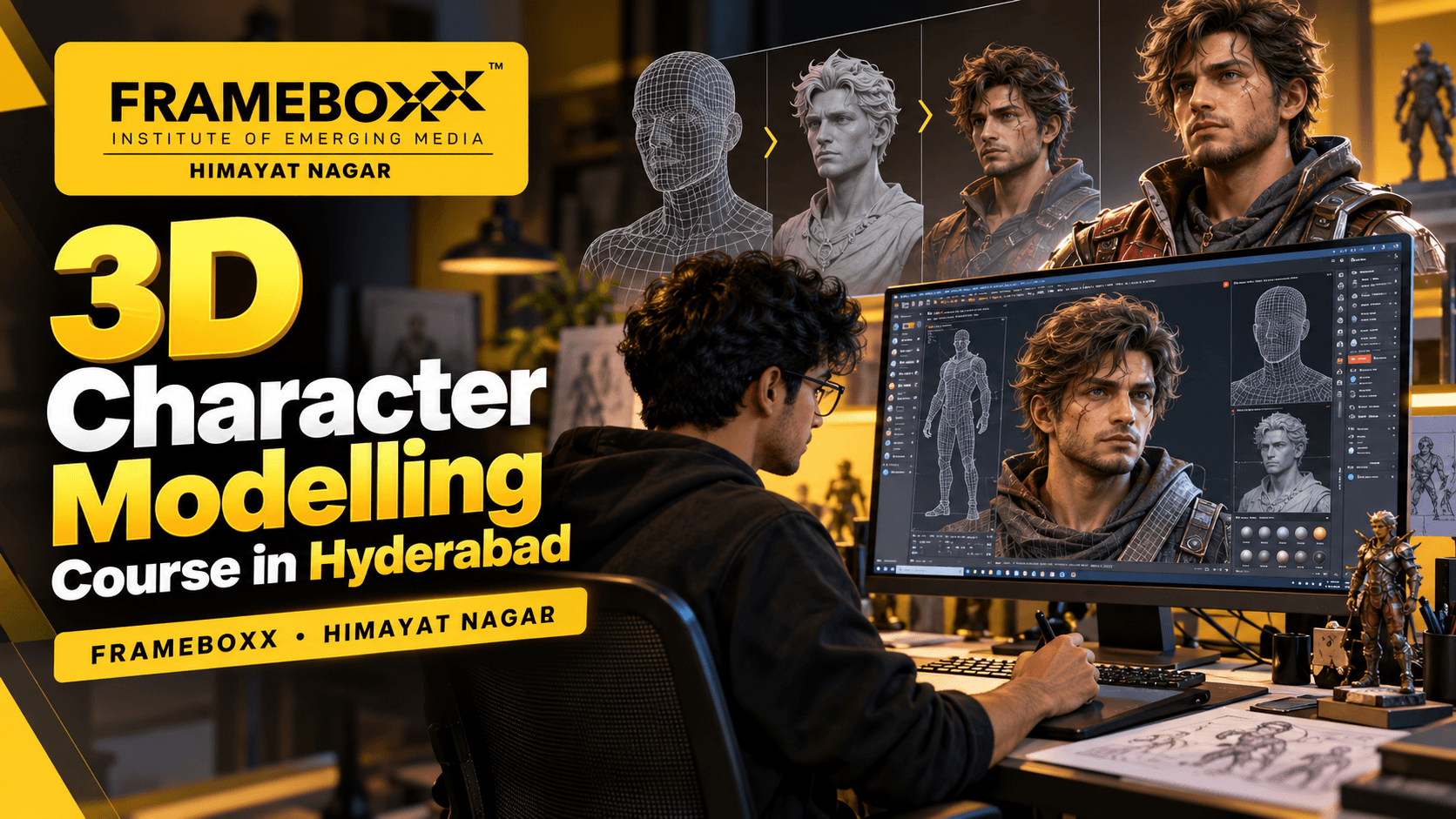
If you want to create 3D human characters, stylised cartoon figures, fantasy creatures or game-ready digital assets, choosing the right 3D Character Modelling Course in Hyderabad is an important first step. The right training should help you understand the complete character creation process, from interpreting a concept and building a 3D shape to refining details, applying materials and presenting a finished model.
At Frameboxx Himayatnagar, Hyderabad, students can explore animation, VFX and gaming education pathways that relate to digital character creation. Before enrolling, it is important to confirm whether the available programme includes dedicated character modelling modules, which software is taught, how practical projects are structured and what portfolio support is provided.
This guide explains the skills involved in 3D character modelling, the learning process beginners should expect, the difference between modelling and animation, and how to evaluate a suitable course in Hyderabad.
What Is a 3D Character Modelling Course in Hyderabad?
A 3D Character Modelling Course in Hyderabad teaches students how to create three-dimensional digital characters using specialised modelling and sculpting tools. These characters may be realistic humans, stylised cartoon figures, animals, fantasy creatures or original designs created for animation and games.
The process involves more than shaping a face or body. A completed character may require appropriate proportions, clean geometry, detailed sculpting, UV mapping, textures, materials and presentation-ready lighting. Depending on the intended use, it may also require a suitable topology and preparation for rigging or animation.
For example, a student might begin with a rough sketch of a fantasy warrior, build the character's body and clothing in 3D, sculpt facial features, add surface details, create materials and produce final renders for a portfolio.
A structured learning pathway helps students understand not only how to use the software but also why different modelling decisions matter.
Why Learn 3D Character Modelling in Hyderabad?
Hyderabad students looking to enter animation, visual effects or game art need to evaluate courses according to their learning goals, practical requirements and accessibility.
When comparing a 3D Character Modelling Course in Hyderabad, consider these factors:
- Practical learning: Does the programme include guided modelling exercises and original character projects?
- Software exposure: Which 3D modelling, sculpting and texturing tools are actually included?
- Portfolio development: Will you complete projects that demonstrate your modelling ability?
- Learning support: Can beginners receive feedback and guidance as their skills develop?
- Specialisation: Does the curriculum cover character modelling specifically, or is it a broader animation programme?
- Career preparation: Does the institute explain relevant job roles, portfolio expectations and the next steps after training?
These questions help you compare courses on meaningful criteria instead of selecting an institute based only on promotional claims.
Skills You Should Learn in 3D Character Modelling Training
A useful character modelling learning path progresses from fundamental concepts to more complex assets.
1. Understanding character design and anatomy
Before opening a 3D application, learn to analyse the character's silhouette, proportions, facial structure, body shape and design language.
For human characters, basic anatomical understanding helps you create believable forms. For cartoon characters, you may deliberately exaggerate the head, eyes, limbs or body proportions to communicate personality.
Reference images and turnaround drawings can help you understand how a character looks from the front, side and back.
2. 3D modelling fundamentals
Modelling involves constructing the surfaces and shapes that make up a character. Students should understand vertices, edges, faces, polygons, mesh structure and subdivision.
Begin with simple objects and gradually work towards organic forms such as heads, hands, torsos and complete figures.
A key skill is learning to create geometry that supports the intended appearance and use of the model, rather than simply adding more polygons.
3. Digital sculpting
Digital sculpting allows artists to shape organic forms using virtual brushes. It is particularly useful for refining facial features, muscles, skin folds, clothing details and creature anatomy.
For example, Blender provides sculpting tools that support organic modelling and detail refinement. Its official documentation explains the different sculpting workflows and tools available to artists.
Learn more in the official Blender sculpting guide.
4. Retopology and clean geometry
A detailed sculpt is not always suitable for animation or real-time games. Retopology involves creating or refining a mesh so that its geometry better suits the intended production workflow.
Students should understand why edge flow matters around the eyes, mouth, shoulders, elbows and knees when a character will need to deform during movement.
The required topology depends on whether the model is intended for a static render, a film production pipeline or a real-time game.
5. UV mapping and texturing
UV mapping establishes how a 2D texture fits onto a 3D model. Texturing adds visual information such as skin colour, fabric patterns, roughness, surface variation and other material details.
A good texturing workflow should complement the geometry and character design. It should not rely on surface detail to hide problems with the underlying model.
6. Materials, lighting and rendering
Materials describe how a surface responds to light, while lighting and rendering help communicate the final appearance of the character.
A portfolio presentation might include a neutral clay render, a textured beauty render and close-up views of the face, hands, clothing and other important details.
These presentation skills help reviewers assess the model's structure as well as its visual finish.
7. Preparing characters for animation or games
Character modelling is related to, but different from, rigging and animation.
If the character needs to move, the model may need to be prepared for a rigging workflow. Depending on the project, this can involve clean deformation topology, appropriate mesh organisation and coordination with the rigging artist.
For game characters, additional considerations may include polygon budgets, texture resolution, level of detail and export requirements for the target engine.
Students should confirm which of these advanced topics are included in the specific programme they plan to join.
Which Software Should You Learn?
The most suitable software depends on the type of character you want to create and the production workflow you intend to follow.
| Software | Typical use | What to evaluate |
|---|---|---|
| Blender | Polygon modelling, digital sculpting, UV mapping, texturing and rendering | Its integrated workflow and suitability for beginners |
| Autodesk Maya | 3D modelling and broader animation production workflows | How modelling connects with rigging and animation |
| ZBrush | Specialised digital sculpting workflows | High-detail organic forms and sculpting techniques |
| Substance 3D Painter | Texture painting and material creation | Whether the course includes a dedicated texturing workflow |
These are examples of relevant tools, not a claim that every tool is included in a particular Frameboxx Himayatnagar programme. Confirm the actual software list before admission.
You can explore the official Autodesk Maya overview to understand its modelling and animation capabilities.
What Projects Should You Complete During Training?
One of the best ways to evaluate character modelling education is to look at the work you will be able to produce.
A progressive project sequence could include the following exercises:
Project 1: Stylised cartoon head
Create a simple character head using reference images. Focus on the silhouette, facial proportions, eye placement, nose, mouth and overall expression.
Learning objective: Understand basic organic forms and facial proportions.
Project 2: Full-body stylised character
Build a complete character with a clear silhouette, appropriate proportions and basic clothing forms.
Learning objective: Combine individual body parts into a coherent character model.
Project 3: Detailed creature or fantasy character
Develop an original creature or fantasy design, paying attention to anatomy, surface forms and distinctive design features.
Learning objective: Practise more advanced modelling and sculpting decisions.
Project 4: Textured character presentation
Prepare a completed character with suitable UVs, textures, materials, lighting and final renders.
Learning objective: Present the model clearly and demonstrate attention to detail.
Project 5: Portfolio-ready character asset
Refine one project based on feedback. Include multiple views and relevant breakdowns that show the model's structure, details and final appearance.
Learning objective: Demonstrate a complete workflow rather than only showing a single attractive render.
These projects are recommended learning exercises, not a representation of confirmed Frameboxx course assignments. Ask the institute for its actual project list and assessment process.
Who Can Join a 3D Character Modelling Course in Hyderabad?
A character modelling learning pathway may suit several types of learners.
Students after Class 10 or Class 12: Students interested in drawing, digital art, animation or games can investigate suitable creative education pathways. Academic eligibility depends on the specific programme.
College students and graduates: Those exploring creative careers can develop 3D production skills alongside their existing education.
Aspiring game artists: Learners interested in designing characters for interactive experiences can focus on modelling, topology, UVs, texturing and real-time asset requirements.
Aspiring animation and VFX artists: Students interested in digital characters for films, animation and visual production can explore modelling as one part of a broader production pipeline.
Working professionals and career switchers: People with an interest in digital art may consider structured training to build practical skills and a portfolio.
You do not necessarily need to be an expert artist before beginning. However, observation, patience, visual problem-solving and regular practice are valuable. Confirm the course's prerequisites before enrolling.
What Is the Difference Between 3D Character Modelling and 3D Animation?
These disciplines work together but involve different responsibilities.
| Aspect | 3D character modelling | 3D character animation |
|---|---|---|
| Main purpose | Create the character's 3D form and surface | Create movement and performance |
| Key skills | Modelling, sculpting, topology, UVs and texturing | Timing, posing, movement, acting and motion refinement |
| Typical output | A finished character asset | An animated performance or sequence |
| Related disciplines | Character design, sculpting and texturing | Rigging, layout and animation |
| Portfolio evidence | Character turnarounds, renders and model breakdowns | Animation shots, acting tests and movement sequences |
A character model may later be rigged and animated, but completing a modelling course does not automatically mean you have mastered animation or rigging.
If you want to specialise in creating characters, look for strong modelling and sculpting coverage first. If your goal is to bring characters to life, ask how the course connects modelling with rigging and animation.
Career Paths After Learning 3D Character Modelling
Character modelling skills can contribute to several creative career pathways, depending on the quality of your work, your specialisation and the requirements of individual employers.
Potential roles to research include:
- 3D character modeller
- Junior 3D artist
- Character artist for games
- Digital sculpting artist
- 3D modelling artist for animation
- Texturing artist, with additional relevant skills
- Generalist 3D artist, with broader production knowledge
The responsibilities differ between studios and projects. Some positions focus on sculpting and modelling, while others expect knowledge of retopology, UVs, texturing, optimisation or rigging preparation.
Course completion alone does not guarantee employment, a particular salary or freelance income. Practical ability, portfolio quality, communication and the ability to meet production requirements all matter.
How to Choose the Right 3D Character Modelling Course in Hyderabad
Before making an admission decision, use this checklist to evaluate the course and institute.
| What to check | Question to ask |
|---|---|
| Curriculum | Does it teach character modelling in sufficient depth? |
| Software | Which applications and versions will you learn? |
| Practical work | How much time is spent creating original models? |
| Feedback | Who reviews projects, and how often? |
| Portfolio | What work will you complete and be able to present? |
| Course duration | What is the total duration and weekly schedule? |
| Eligibility | What academic or technical prerequisites apply? |
| Fees | What is the complete fee, including any additional costs? |
| Career support | Is career guidance or placement assistance available, and what exactly does it cover? |
| Learning format | Is training classroom-based, online or offered in another format? |
Ask to see examples of student work and request a detailed syllabus before committing. A course title alone does not tell you how much time is devoted to modelling compared with other subjects.
Explore 3D and Animation Education at Frameboxx Himayatnagar
Frameboxx Himayatnagar is located at 6th Floor, Mahaveer Chambers, Chandra Nagar, Himayatnagar, Hyderabad, Telangana 500029. Its website lists Animation & VFX and Gaming & Interactive among its programme categories.
For students interested in character creation, these are relevant areas to discuss with the admissions team. The most important next step is to establish which available programme aligns with your intended specialisation.
Before enrolling, ask for confirmation of:
- Whether a dedicated 3D Character Modelling Course in Hyderabad is currently available.
- Whether character design, organic modelling and digital sculpting are covered.
- Which software is included in the curriculum.
- Whether students complete original character projects.
- The course duration, fees and eligibility requirements.
- The type of portfolio guidance and career support available.
Review the Frameboxx Himayatnagar website for current programme information, or visit the official course information website.
Ready to explore your options? Contact Frameboxx Himayatnagar to discuss your interest in 3D character modelling and request the latest curriculum details before choosing a programme.
Start Your 3D Character Modelling Learning Journey
Creating a compelling 3D character requires a combination of visual judgement, technical modelling skills and consistent practice. The best course for you is one that matches your current level, teaches the skills you actually need and gives you opportunities to develop original portfolio work.
If you are searching for a 3D Character Modelling Course in Hyderabad, compare the curriculum, software, projects, duration, fees and career support before making a decision.
Explore the animation and gaming education options at Frameboxx Himayatnagar, discuss your specific character-art goals with the admissions team, and confirm the current programme details before enrolling.